Most mornings in the McMurdo Dry Valleys start the same way: convincing myself to leave my sleeping bag and step into the cold with the promise of coffee. For two months each year, our team maintains the meteorological and limnological stations that support the McMurdo Long Term Ecological Research (LTER) project.
We work in the largest ice-free region in Antarctica. There’s no vegetation, no wildlife, and the only sounds are wind and the occasional crack of shifting ice. Though some days begin with the thumping of a helicopter approaching camp. We pack our gear (calibrated sensors, replacement parts, lots of snacks, a toolkit that somehow must solve whatever problem arises) and fly out to one of our met stations. Bolted in ice or permafrost, the met stations have done their best to withstand the winter, but inevitably something is broken when we arrive. In the harsh conditions, cables stiffen, connectors freeze, and sometimes sensors get snapped off in the wind. This often makes our routine maintenance feel anything but routine. Straightforward tasks can turn into puzzles: dead batteries, a sensor that won’t wake up, telemetry that doesn’t work when there isn’t a single reason for it not to. The work requires a mix of patience and improvisation, and a lot of handwarmers.
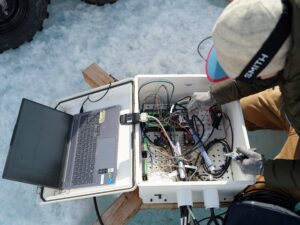
Other days take us onto the lake ice. Below several meters of permanent ice cover, the lakes stay liquid year-round thanks to unique chemistry and are sustained by brief pulses of glacial meltwater. We maintain our “Blue Boxes,” sensor stations that monitor PAR, dissolved oxygen, ice ablation, and other physical lake properties. Field repairs here have their own challenges. Pulling a sensor from the water can freeze it in seconds, and storms coat equipment with a fine layer of frozen dust that gets into everything. We warm connectors against our gloves, try again, swap parts, and try again. When an instrument finally responds, the win is small but meaningful, a small success that protects the integrity of a long-term record.
Between maintenance trips this season, I’ve been able to fit in my own research using seismology on Taylor Glacier to investigate subglacial hydrology. I’m interested in the brine system feeding Blood Falls and the processes that trigger its occasional flow events. It’s work that blends glaciology, limnology, and hydrogeology, disciplines that intersect naturally in the Dry Valleys.
When people ask what it’s like to work there, I wish I could hand them a moment of the valley’s silence or the soft blue light filtering through the lake ice. Instead, I tell them this: our job is to keep the record going in a place where change happens slowly and often imperceptibly. The Dry Valleys may look barren, but their stories live in wind speeds, lake levels, and short-lived melt seasons. Our work ensures those stories are recorded.